Meet Kate
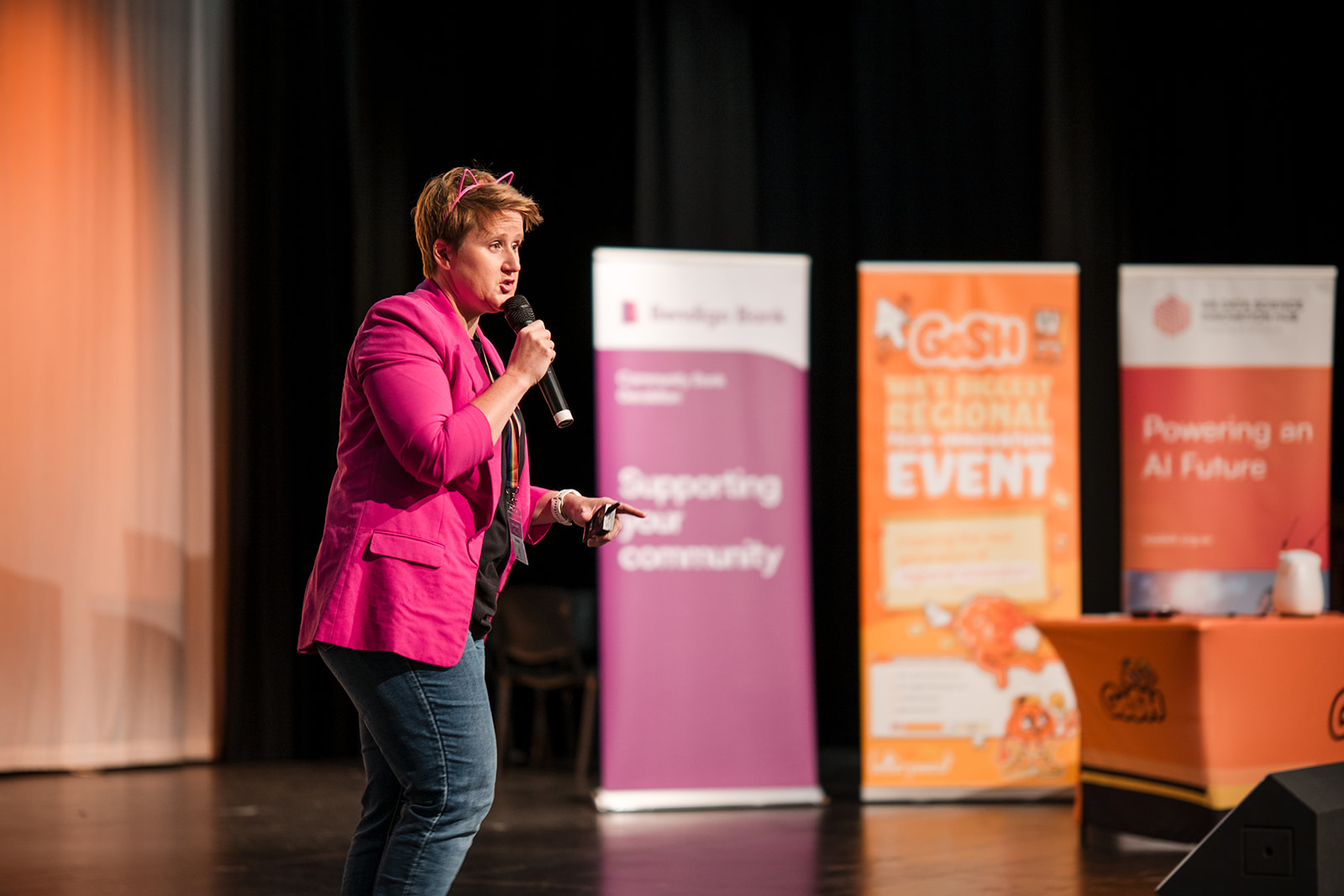
Kate Alderson is the Founder and CEO of Freeater, a food confidence platform helping people with food allergies, coeliac disease and other dietary needs discover places to eat and shop with greater confidence. Based in Derby, England, she brings together a background in architecture, management, research and entrepreneurship to address a problem she first encountered through her own family and friendship circles.
An Entrepreneurial Instinct That Started Young
Long before Kate Alderson founded a technology business, she was already experimenting with what it meant to create something of her own. At 17, she started an art business, working with international clients and building a social media following of around 1,500 people within three months. Her work was also exhibited as part of Wales Contemporary.
At the time, she did not necessarily see herself as an entrepreneur. It was simply something she was drawn to. Looking back, however, the instinct is easy to recognise. She enjoyed creating, connecting with people and seeing an idea become something tangible.
Her academic path initially took her in a different direction. She studied architecture at Loughborough University and later at the University of Cambridge, where she developed a strong foundation in research, design and creative problem solving. Architecture taught her to look closely at how people interact with the world around them and to think carefully about the relationship between a problem and the person experiencing it.
Over time, her curiosity moved beyond the built environment. She became increasingly interested in the commercial side of bringing ideas to life and went on to complete an MSc in Management at Loughborough University. She graduated with distinction and as the top performing student on her course.
These experiences might appear separate when viewed individually. Art, architecture, management and entrepreneurship occupy different spaces. For Kate, however, they gradually became connected. Each taught her something about understanding people, examining problems and finding ways to turn ideas into practical solutions.
When a Personal Experience Became a Bigger Question
Freeater began in 2024, not because Kate was searching for a business idea, but because she had encountered a problem that felt worth understanding.
Through family and friends with different dietary needs, she had seen how something as ordinary as deciding where to eat could become complicated. When one person has a food allergy, another has coeliac disease and someone else has a different dietary requirement, an apparently simple meal can require research, questions and careful planning.
The experience stayed with her.
Rather than immediately assuming she knew how widespread the issue was, Kate began researching it. She wanted to understand whether the difficulties she had witnessed within her own circles reflected a wider experience.
That research became extensive. She conducted more than 650 interviews and surveys before working with 200 beta testers. The conversations helped reveal that the challenge extended well beyond her family and friends.
For Kate, that process was important because it gave the idea a foundation in other people’s experiences rather than simply her own assumptions.
It was also where her different areas of experience began to meet. Her architecture background had trained her to understand users and examine problems from their perspective. Her management education gave her another lens through which to consider how an idea could become a viable business. Her earlier experience in art had already shown her what it meant to build something independently.
Freeater became the place where those strands came together.
Learning to Build Without a Blueprint
Moving from architecture into management and eventually entrepreneurship was a significant transition. Each field demanded a different way of thinking, yet Kate discovered that the skills were more connected than she had expected.
Architecture had taught her to research, observe and design around people’s needs. Entrepreneurship required many of the same instincts, but with a greater degree of uncertainty.
There was no finished blueprint for Freeater. Kate had to make decisions while the business was still taking shape, learn from users, understand the needs of businesses and adjust the platform as new information emerged.
That uncertainty became one of the defining challenges of building the company.
She learned to approach it in much the same way she had approached design. Instead of expecting to have every answer at the beginning, she focused on understanding the problem, testing ideas and listening to the people affected by it.
Her research became an ongoing process rather than a stage that ended when Freeater launched.
This mindset has shaped how she thinks about leadership too. Kate values curiosity, integrity and persistence, but she also understands that conviction does not mean refusing to change. Listening carefully can sometimes mean discovering that an assumption needs to be reconsidered.
For a founder, that balance can be difficult. There is a need to trust your judgement while remaining open to information that challenges it. Kate has gradually become more comfortable holding both positions at once.
The Moment Freeater Became Something People Could Use
The launch of the Freeater App in May 2026 marked a major transition.
Until then, Freeater had existed as an idea being researched, tested and developed. With the launch, it became something people could actually use.
For Kate, that distinction mattered.
The journey that followed brought several moments of recognition, including appearances on BBC News and radio, becoming a finalist in the UK StartUp Awards and being named a #SBS Small Business Sunday winner. Yet the significance of those experiences seems to lie less in the recognition itself and more in what they represented.
Each one offered a moment to step back and see how far the original idea had travelled.
The same is true of another part of Kate’s work that sits outside the technology platform. She published her first children’s book, Alex and the Feel Good Foods, creating another way to introduce children and families to conversations about food allergies, coeliac disease and dietary differences.
The book reflects something important about her wider approach. The problem Freeater addresses is not only about finding information when choosing somewhere to eat. It is also connected to understanding, awareness and inclusion.
Teaching children about dietary differences can help make those conversations more familiar from an early age.
Kate describes the broader purpose simply:
“At its heart, Freeater is about giving people greater confidence around food.”
That confidence can take different forms. It might mean someone feeling comfortable trying a new restaurant. It might mean a family finding a place where everyone can eat without the usual uncertainty. It might mean a business communicating more clearly about its food and dietary options.
The common thread is making everyday experiences a little easier.
Making Inclusion Part of Everyday Life
Freeater is expanding beyond eating out and into shopping, reflecting the reality that dietary needs affect more than one part of daily life.
The platform is designed to help people discover places and businesses that better suit their requirements while encouraging businesses to communicate more clearly about how they cater to different needs.
For Kate, this is not simply a technology problem.
Technology can make information easier to find, but a more inclusive food culture also depends on conversations between people, businesses, families and communities. That is why her work through the children’s book and other educational efforts sits alongside Freeater rather than apart from it.
She has also continued to support younger people through tutoring and mentoring. Across these different activities, there is a consistent interest in helping people understand something that may previously have seemed unfamiliar.
That purpose appears to be an important part of how Kate measures her work.
She does not define success only through business growth. A sustainable company matters, but so does whether the company creates something genuinely useful.
If someone with dietary restrictions feels able to visit somewhere new, that matters. If a family can choose a place to eat without spending hours researching, that matters. If a child grows up with a better understanding of food allergies and dietary differences, that matters too.
The impact is often found in small moments.
Looking Beyond the Next Milestone
Kate’s ambition for Freeater is to continue growing the platform into something that can support people throughout more of their everyday experiences with food.
That includes expanding the shopping side of the platform, growing its community, working with more businesses and continuing to improve the service based on what users tell her they need.
The educational side of her work is also something she wants to develop. She hopes to work with more schools and communities through Alex and the Feel Good Foods, creating opportunities for children to learn about food allergies, coeliac disease and dietary differences at an early age.
The long term vision is broader than an app.
Kate wants Freeater to help make navigating food with dietary needs easier wherever people are, while contributing to a culture in which those differences are understood more naturally.
It is an ambitious goal, but one rooted in the same question that started the company: how can an everyday experience become easier for more people?
Her answer continues to evolve as she learns from the people using the platform.
Staying Curious While Trusting the Journey
Kate’s own career provides an interesting reminder that professional paths rarely develop in a straight line.
At 17, she was running an art business. She later studied architecture at Loughborough and Cambridge, pursued management, and eventually founded a technology company focused on food inclusion.
None of those stages necessarily pointed directly to the next one.
That is part of what makes her story distinctive. The value of each experience only became clearer with time.
She carries lessons from architecture into entrepreneurship, lessons from management into business building and lessons from her early creative work into the process of creating something from the ground up.
She also understands the importance of stepping away from work. Travelling, cycling and spending time with friends and family give her space to reset and sometimes see a problem differently.
For someone naturally driven and focused on what comes next, looking back can be equally valuable. Progress can become difficult to notice when attention is always fixed on the next challenge.
Kate makes a point of occasionally returning to the beginning and remembering how much has changed.
Her advice to others reflects that perspective:
“Don’t feel that your career has to follow a perfectly straight path.”
It is advice that comes naturally from her own experience. The path from an art business at 17 to architecture, management and Freeater was not mapped out in advance. It developed through curiosity, research, opportunity and a willingness to follow problems that felt meaningful.
Building Something That Matters
There is a quiet consistency in Kate Alderson’s approach to her work.
She begins with questions. She listens before assuming. She researches before building. She tests ideas and accepts that some of them will need to change. At the same time, once she believes a problem is worth addressing, she is willing to keep moving forward despite uncertainty.
That combination has shaped Freeater and, in many ways, reflects the person behind it.
Her ambition is not simply to create a successful company. She wants to build something with lasting value, something that can make ordinary experiences more accessible and less uncertain for people with dietary needs.
The story of Freeater is therefore not only about technology or entrepreneurship. It is about noticing an everyday difficulty and choosing to look at it more closely. It is about taking a personal observation seriously enough to investigate it, then listening carefully enough to discover that the experience belongs to many others too.
For Kate, the journey is still unfolding. But the idea that began with conversations among family and friends has already grown into a platform, a community and an educational effort.
And perhaps that is where her journey comes full circle. The young artist who once built something of her own was already learning the instinct that would later guide her as a founder: start with something you care about, pay attention to the people around you, and see where the idea can take you.
For More Features
Be Featured in The Real Edit!
Every story has the power to shape how we see innovation, leadership, and purpose. If you’re a founder, creator, executive, or changemaker with a journey worth telling , we’d be honored to help you share it.
To inquire about being featured:
Email us at: info@realedit.site
Follow The Real Edit