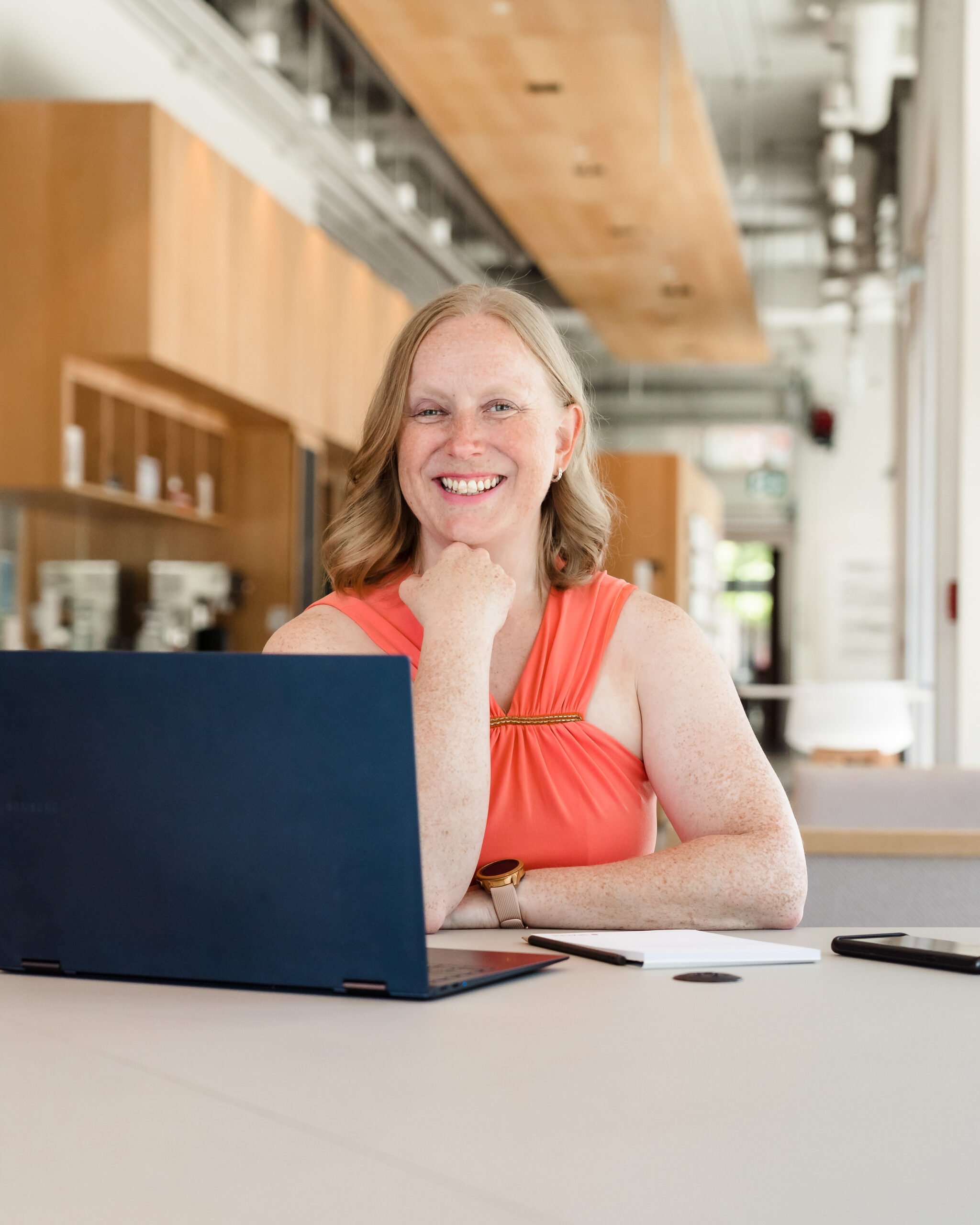
Meet Oluwaranti
Oluwaranti Damilola Adediran is a Nigerian entrepreneur, Founder and CEO working across technology, education, digital innovation, and social impact. She is the Founder and CEO of WITTI, Founder and CEO of CodeSchool Africa, and Founder and Program Director of TechHer4Change Women Empowerment Foundation. Her work centers on expanding access to digital skills, economic opportunity, and greater independence for young Africans, women, and underserved communities.
From Marketing to a Larger Question
Oluwaranti Damilola Adediran did not begin her career with a single, fixed idea of what her professional life would become. Her early work was rooted in marketing and communications, where she developed an understanding of business development, strategy, growth, and the human side of building organisations. She learned how ideas are communicated, how teams are formed, and how businesses can turn opportunities into sustainable growth.
Those experiences gave her a strong commercial foundation, but they also gradually led her toward a larger question about what business could make possible for people beyond the immediate goals of revenue or expansion.
Her career moved through leadership roles in marketing and eventually into entrepreneurship. She became Co Founder and COO of a technology product studio, gaining experience in building teams, developing products, and taking responsibility for the wider direction of a business. With each step, she became more interested in the intersection between technology, education, entrepreneurship, and the social realities affecting people across Africa.
The shift was not about abandoning what she had learned. Instead, she began applying those skills to problems that felt more consequential.
At the center of that transition was a belief that opportunity can change the direction of a person’s life when the right skills and support are available. Africa has no shortage of talent, but access to quality education, technology, networks, and economic opportunities remains uneven. For Oluwaranti, that gap became something worth working on directly.
“I became increasingly interested in using those same skills to solve broader social and economic challenges.”
That realization eventually shaped the work she is doing today.
When Growth Became About People
One of the most important changes in Oluwaranti’s journey came when she began looking at entrepreneurship through a different lens. Building a successful organisation was still important, but success could no longer be measured only through commercial growth.
She began asking what she could build that would create opportunities for other people.
That question became particularly meaningful through CodeSchool Africa. As Founder and CEO, she has helped more than 20,000 young Africans develop technology skills and has worked with strategic partners to expand access to technical education. For her, the value of that work is not simply found in the number of people trained. It lies in what those skills can unlock afterward.
A young person who gains access to relevant technology skills may discover a career they had never considered. They may find a pathway into the digital economy, develop a source of income, or gain the confidence to imagine a professional future that once felt distant.
This understanding of education as a pathway rather than an endpoint also shaped WITTI, where Oluwaranti is building an AI powered learning management system and digital creator platform. The platform has supported more than 5,000 learners across more than 10 African countries and has empowered more than 1,000 educators and content creators to monetize their expertise.
The idea reflects a broader part of her thinking. Education is changing, and access to information alone is no longer enough. People need learning experiences that are relevant to their circumstances, useful in the real world, and capable of helping them turn knowledge into opportunity.
For Oluwaranti, technology has value when it makes those possibilities more accessible.
A More Personal Understanding of Independence
Her work with TechHer4Change has added another, deeply personal dimension to her understanding of empowerment.
Through the Women Empowerment Foundation, Oluwaranti works with expert trainers to provide technology and digital skills to abused and marginalized women and girls. The goal is not simply to teach a technical skill. It is to help create the conditions in which women can begin to regain economic independence and make choices about their own lives.
Working in this space has also shown her that independence cannot always be separated from emotional wellbeing.
A woman experiencing abuse may be told that she needs to leave, but leaving can be extraordinarily difficult when she has limited financial resources, few skills, little confidence, or no support system. Economic dependence can become part of the structure that keeps someone trapped.
That reality has influenced the way Oluwaranti thinks about solutions. Through TechHer4Change, the organisation works not only on digital and economic empowerment but also with certified psychologists to support the mental and emotional wellbeing of women and girls affected by abuse and marginalization.
This has changed her understanding of what meaningful impact looks like.
Transformation, she has learned, rarely happens in a straight line. Skills matter. Income matters. But confidence, healing, community, and the ability to imagine a different future matter too.
Her experiences with women and girls have therefore made her approach to leadership more patient and more human. The objective is not simply to create a programme and measure its immediate output. It is to understand the person behind the problem and consider what support might help them move forward.
Learning to Build Through Uncertainty
Leaving the relative predictability of a corporate career for entrepreneurship brought its own challenges. Building a business requires a willingness to operate without certainty, to make decisions without having every answer, and to take responsibility when plans do not unfold as expected.
For Oluwaranti, those experiences became an education in resilience.
There were moments when things did not go according to plan. Rather than allowing those setbacks to define what was possible, she learned to focus on the problem she was trying to solve and adapt the route toward it.
That mindset has remained important as she has built solutions for communities that are often underserved by existing systems. Creating accessible digital education requires more than developing content. It requires understanding what learners actually need, building partnerships, considering affordability and relevance, and thinking carefully about how skills can translate into economic opportunity.
Those challenges have shaped her leadership as much as her successes have.
She has learned that resilience is not about ignoring difficulty. It is about acknowledging what is difficult, understanding what can be changed, and continuing with greater clarity. The process has also strengthened her empathy.
Her work has brought her into contact with people whose circumstances are very different from her own. Listening to their experiences has reinforced the importance of designing solutions around real human needs rather than assumptions.
During difficult periods, she focuses on what she can control, breaks larger problems into smaller steps, and gives herself room to pause. She also stays connected to people she trusts and returns to the reason behind the work.
That connection to purpose has become one of the quiet forces behind her career.
Measuring Success by What Becomes Possible
Oluwaranti’s definition of success has changed alongside her career.
Earlier in her professional life, growth and business performance naturally formed part of the picture. Today, she looks more closely at what happens to people after they encounter something she has helped build.
Her work with CodeSchool Africa has reached more than 20,000 young Africans with technology skills. WITTI has created learning and monetization opportunities across multiple African countries. TechHer4Change has created pathways for women and girls affected by abuse and marginalization to develop skills and begin rebuilding economic independence.
Yet she does not speak about these figures as the final measure of her work.
For her, the deeper question is what those numbers represent.
A learner may leave a programme with greater confidence. An educator may discover that her knowledge can become a sustainable source of income. A woman may begin to see economic independence as one step toward making choices about her future.
These changes may not always be visible immediately, but they are central to the reason she continues building.
“I am proudest that my work has evolved from building businesses to building possibilities for other people.”
That shift captures the evolution of her professional identity. She is still a founder, strategist, and business leader, but her ambitions have expanded beyond what she can personally accomplish. She is increasingly interested in building platforms and institutions that allow other people to create their own opportunities.
Building for a More Inclusive Digital Africa
Looking ahead, Oluwaranti wants to scale the work she has already begun while making it more sustainable.
With WITTI, she hopes to broaden access to quality digital education across Africa and develop partnerships that can connect underserved communities with technology, education, and future ready skills.
At TechHer4Change, she wants to reach more women and girls while strengthening the support systems available to those rebuilding their lives after abuse. The work is likely to remain rooted in digital skills and economic opportunity, but with an understanding that sustainable change requires attention to the wider circumstances surrounding a person’s life.
More broadly, she sees her future at the intersection of technology, education, and social impact.
She is interested in solutions that can move beyond individual programmes and become sustainable platforms for opportunity. That means thinking not only about what can be built today but also about whether an organisation can continue creating value when its founder is no longer involved in every decision.
That is an important part of her vision for leadership. Building something meaningful also means building people, systems, partnerships, and structures capable of carrying the work forward.
Her ambitions are substantial, but they are grounded in a desire to remain connected to learning and personal growth. She wants to take on larger challenges without losing the values that have guided her so far.
Staying Human While Building Forward
The values that guide Oluwaranti are purpose, integrity, resilience, empathy, and continuous growth.
Purpose keeps her connected to the reason behind her work. Integrity reminds her that leadership carries responsibility. Resilience helps her navigate uncertainty without losing sight of the larger picture. Empathy keeps her attentive to the realities of the people she serves. Continuous growth prevents her from becoming too comfortable with what she already knows.
Together, those principles provide a framework for a career that has moved through several different worlds.
She began in marketing and communications. She moved into business leadership and technology. She became increasingly involved in education and human capital development. Her work eventually expanded into social impact, particularly through her commitment to women and girls affected by abuse and marginalization.
What connects these chapters is not a particular industry. It is the question of what knowledge, technology, and opportunity can make possible when they reach people who have historically had less access to them.
Oluwaranti also draws inspiration from people who combine ambition with purpose, particularly leaders who challenge established ways of thinking and build solutions where they see gaps. She looks to Dr. Ngozi Okonjo Iweala as one example of the kind of leadership she admires, particularly her resilience, intelligence, and commitment to Africa’s development.
But some of her strongest inspiration comes from the people she encounters through her own work. Young people who continue learning despite difficult circumstances, educators who share their knowledge, and women who find the courage to rebuild after painful experiences all reinforce her belief that progress is often built through persistence.
A Career Built Around Possibility
There is a consistent thread running through Oluwaranti Damilola Adediran’s story. It is not simply entrepreneurship, technology, education, or social impact. It is possibility.
Her work is concerned with what happens when someone gains access to a skill they did not have before, when an educator discovers a new way to earn from her knowledge, or when a woman begins to see economic independence as part of a life beyond abuse.
That perspective has changed the way she understands leadership. Being a leader is not only about standing at the front of an organisation or making important decisions. It is also about creating conditions in which other people can move forward.
Her advice to people building their own careers reflects the same philosophy. She believes people should allow themselves to begin before they feel completely prepared, remain open to mistakes and changes in direction, and avoid measuring their progress too closely against someone else’s timeline.
Her own journey is evidence of that approach. A career that began in marketing became a path through entrepreneurship, technology, education, human capital development, and social impact. The different chapters did not cancel one another out. Each one gave her another set of skills and perspectives to carry into the next.
For Oluwaranti, the future is therefore not about arriving at a final version of herself. It is about continuing to learn, build, adapt, and create room for others to do the same.
What she is building may take the form of platforms, educational programmes, partnerships, and organisations. But underneath all of them is a simpler ambition: to leave people with more choices than they had before.
And perhaps that is the clearest measure of the journey she has chosen. Not simply how far she has gone, but how many other people can move forward because she decided to build something.
For More Features
Be Featured in The Real Edit!
Every story has the power to shape how we see innovation, leadership, and purpose. If you’re a founder, creator, executive, or changemaker with a journey worth telling , we’d be honored to help you share it.
To inquire about being featured:
Email us at: info@realedit.site
Follow The Real Edit