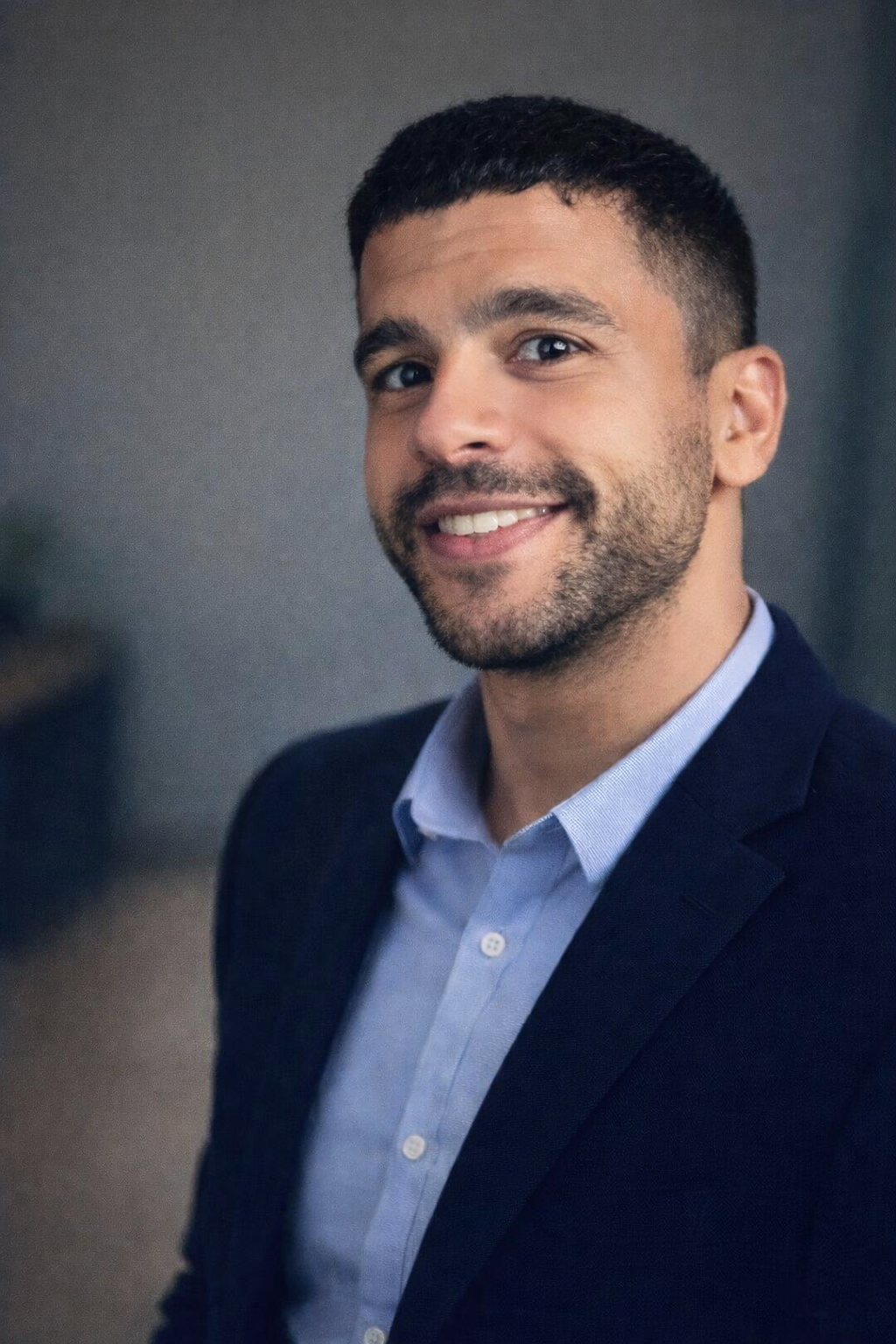
Meet Fredéric
Fredéric Emil Grønhøj Jensen is the COO and Co founder of Peaky, a Copenhagen based company focused on helping organizations build healthier and more effective leadership cultures. With nearly two decades of experience leading teams across the Nordic corporate world, he has worked in customer service, operations, and large scale leadership roles before dedicating himself to reshaping how leadership is practiced and supported inside organizations.
Learning to Move Between Different Worlds
Long before he managed hundreds of employees or built a leadership platform, Fredéric Emil Grønhøj Jensen learned how to observe people closely. He grew up between two very different realities. On one side was the polished world of privilege and elite education. On the other was the emotionally intense environment created by his parents’ work running a residential facility for young people with severe behavioral challenges.
That contrast shaped him early. It taught him that human behavior rarely fits neatly into categories. It also showed him that people carry invisible struggles no matter where they come from. The polished executive and the troubled teenager often want the same things beneath the surface. They want to feel understood, respected, and safe.
He later attended Herlufsholm in Denmark, one of the country’s most prestigious boarding schools. The environment demanded discipline and resilience, but the deeper education came from constantly shifting between social realities. It forced him to become adaptable and emotionally aware long before he entered leadership roles himself.
After serving as a Sergeant in the Danish military, he entered the corporate world through what many would consider an ordinary entry point. He began as a customer service agent at Telia. The pace of his rise surprised even him. Within two months he became a Team Leader. By the age of twenty three, he was managing nearly one hundred people at Callme as Customer Service Manager.
From the outside, it looked like success arriving quickly. Inside, however, he was beginning to understand how unprepared many leaders actually are when responsibility suddenly lands on their shoulders.
The Loneliness Behind the Promotion
One memory still stays with him years later. At twenty three, he stood in the lobby of his office holding an invoice he could not understand. It was a bill for branded entrance mats in the building foyer. He spent nearly an hour walking around the office trying to figure out what exactly he was paying for.
The moment itself sounds small. Yet for him, it carried something much larger.
“I realized I was responsible for everything, from the mats on the floor to the careers of 100 people, and I had no idea what I was doing.”
What struck him most was not confusion about the invoice itself. It was the sudden realization that leadership could feel deeply isolating. There was no manual, no real mentorship, and no system guiding him through the emotional and operational complexity of managing people.
Over the next several years, he continued moving through larger organizations including Visma, Mercedes Benz, Hi3G, and eventually Allente, part of the Viaplay Group. His responsibilities grew rapidly. At Allente, he oversaw four hundred employees across four countries, balancing different cultures, personalities, and operational demands at the same time.
Yet despite the increasing scale, one thing remained consistent. Most organizations promoted people into leadership without properly teaching them how to lead.
Fredéric speaks openly about the failures that shaped him. He often says he has seventeen years of leadership experience, but only seven years of true leadership understanding because the first ten years were spent learning through mistakes. Some of those lessons came through difficult experiences with managers who relied on fear, ego, or emotional volatility rather than trust and accountability.
He remembers leaders smashing tables in frustration. Others told him directly that he would never become a real leader. None of those experiences made him want to repeat the same patterns. Instead, they sharpened his understanding of what leadership should never become.
The deeper frustration was systemic. Organizations invested heavily in sales systems, financial tools, and operational frameworks, yet leadership itself was often left to instinct. Managers were expected to navigate human complexity through gut feeling alone.
That absence became the foundation for what would later become Peaky.
Building Something He Once Needed Himself
The idea behind Peaky did not emerge from trend forecasting or startup ambition. It came from exhaustion, frustration, and a desire to solve a problem he personally lived through for years.
Managing large teams across multiple countries taught him that poor leadership rarely begins with bad intentions. Most managers simply lack support, structure, and clarity. They are promoted because they perform well individually, not because they have been trained to guide others.
Fredéric became especially frustrated with what is commonly known as the Peter Principle, where talented specialists are promoted until they reach a role they are no longer equipped to handle. In his view, this harms both employees and leaders. The employee loses confidence while the manager carries growing pressure without guidance.
At the same time, he saw companies relying heavily on anonymous engagement surveys that often created more distance than trust. Employees became tired of answering surveys that rarely produced meaningful change. Managers were held accountable for team data but lacked tools to address problems in real relationships.
For Fredéric, leadership could not be reduced to spreadsheets and quarterly scores alone. He believed organizations had become overly obsessed with measuring outcomes while ignoring the human behaviors that actually create those outcomes.
His philosophy became centered around behavioral leadership. Instead of chasing endless KPIs, leaders needed to focus on daily actions, emotional awareness, and human connection. Technology, in his view, should support relationships rather than replace them.
“We are proving the feel good, perform good cycle. By making soft values reportable and actionable, we are helping organizations realize that culture is their most valuable financial asset.”
That thinking became the backbone of Peaky’s Leadership Operating System. The platform was designed to function less like a surveillance tool and more like a guide for both leaders and employees. Fredéric often describes it as a GPS for leadership. Not something that takes control away from managers, but something that helps them see blind spots before problems escalate.
The impact quickly became measurable. Some organizations using Peaky saw employee absence rates fall dramatically within months. But for Fredéric, the numbers matter less than the human shift behind them. What matters most is when a leader finally feels equipped rather than isolated.
Leadership as Human Responsibility
Listening to Fredéric speak about leadership, one theme returns constantly. Decency.
Not charisma. Not dominance. Not perfection.
Simply decency.
He believes modern leadership has become unnecessarily complicated. Beneath frameworks, metrics, and strategy sessions, leadership still comes down to whether a person is willing to take responsibility for relationships and behave honestly toward others.
That includes admitting mistakes openly.
For him, one of the most powerful moments a leader can offer an employee is a sincere apology. In workplaces where many people protect authority at all costs, vulnerability becomes surprisingly rare. Yet he sees accountability as essential for building trust and psychological safety.
This belief also shapes how he views communication. He encourages younger leaders to spend less time speaking and more time listening. In his experience, many managers become so focused on appearing capable that they stop learning from the people around them.
The philosophy is deeply personal. During some of the busiest years of his life, he balanced demanding executive roles while simultaneously building Peaky and raising his daughter. There were periods where fifteen hour workdays became routine. What kept him grounded was not ambition alone but the belief that the mission itself mattered.
The growing disengagement crisis in workplaces only strengthened that conviction. Studies showing declining employee engagement confirmed what he had witnessed firsthand for years. Many employees were disconnected not because they lacked work ethic, but because they lacked supportive leadership.
Fredéric does not speak about leadership with idealism. He speaks about it as a craft requiring structure, training, humility, and discipline.
Looking Beyond Software
Although Peaky continues to grow as a technology company, Fredéric’s long term vision reaches beyond software itself.
He believes society fundamentally misunderstands leadership education. In most professions, people are trained before receiving responsibility. Leadership, however, often works in reverse. People receive authority first and then attempt to learn while carrying real consequences for others.
He wants to change that model entirely.
His future vision includes working alongside educational institutions, professors, and policymakers to establish more practical leadership education rooted in real world application rather than abstract theory. He imagines a future where leadership is treated with the seriousness of other licensed professions.
The goal is not to create perfect leaders. It is to ensure that fewer people feel abandoned in leadership positions without support.
At the heart of that vision is something deeply human. Fredéric remembers what isolation felt like during those early years. He remembers the uncertainty behind the title and the pressure of carrying responsibility without guidance.
Everything he is building now seems connected to preventing others from carrying that same loneliness alone.
A Different Definition of Strength
There is an interesting contradiction in Fredéric’s story. He spent years inside high performance corporate environments where results, efficiency, and targets dominated daily life. Yet the lessons he speaks about most often are emotional ones.
Connection matters.
Listening matters.
Humility matters.
For someone inspired by both military discipline and team sports culture, his understanding of strength feels unusually grounded in empathy. He often references leadership as a collective responsibility rather than individual power. Even his admiration for figures like Ray Lewis comes not from athletic dominance alone, but from the ability to elevate the people around them.
That perspective feels central to how he approaches both work and life today.
Leadership, in his eyes, is not about becoming untouchable. It is about becoming accountable. It is about showing up consistently for people while remaining honest about your own imperfections.
In a business world that often celebrates certainty and control, Fredéric Emil Grønhøj Jensen continues to build from a different premise entirely. People do not need more managers pretending to have all the answers. They need leaders willing to learn, listen, and take responsibility for the environments they create.
Perhaps that is why the memory of standing alone in that office lobby still matters so much to him. It was not really about the branded mats on the floor. It was the moment he understood how heavy leadership can feel when nobody teaches you how to carry it.
Now, years later, his work is focused on making sure fewer people have to figure it out alone.
For More Features
Be Featured in The Real Edit!
Every story has the power to shape how we see innovation, leadership, and purpose. If you’re a founder, creator, executive, or changemaker with a journey worth telling , we’d be honored to help you share it.
To inquire about being featured:
Email us at: info@realedit.site
Follow The Real Edit