


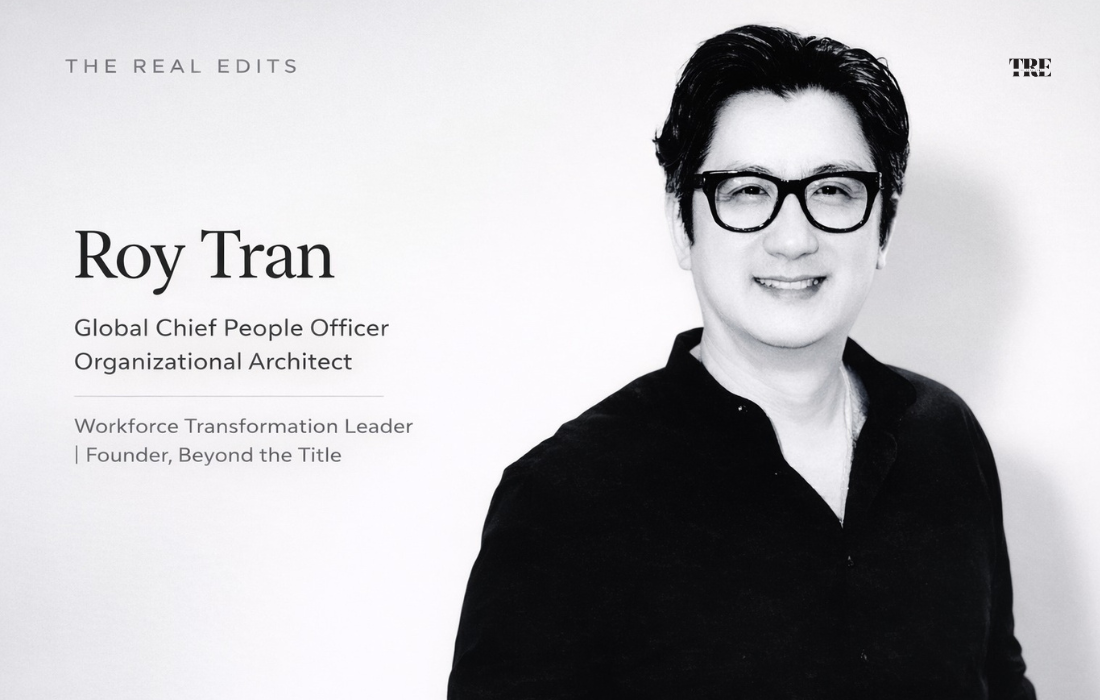

Meet Roy
Roy Tran is a Global Chief People Officer and organizational architect working between Toronto and Ho Chi Minh City. Over the past two decades, he has led workforce transformation across highly regulated institutions and fast-scaling companies, focusing on building leadership and operating systems that outlast the individuals who run them.
Over the course of his career, Roy has held senior leadership roles at Walmart Canada, HSBC, Maple Leaf Foods, and the Ontario Lottery and Gaming Corporation. He also served as Director of People Experience and Transformation for the City of Toronto, governing workforce strategy for 35,000 employees during the COVID-19 pandemic. He currently serves as Global Chief People Officer for Pizza 4P’s, overseeing people operations across Vietnam, Cambodia, Indonesia, Japan, and India. He holds a Certified Human Resource Leader (CHRL) designation and a Project Management Professional (PMP) certification.
Where It Begins
Roy Tran’s understanding of systems did not begin in a boardroom. It began on a wooden boat.
Born in Hanoi in the mid-seventies, Roy was part of the Vietnamese refugee crisis that displaced hundreds of thousands of families across Southeast Asia. Rescued at sea and processed through a military base in Alberta, his family was sponsored by the United Church of Canada and rebuilt their lives in Toronto from nothing. His father spent thirty years on a factory floor. His mother spent her career as a federal payroll administrator, processing the wages of thousands of people who never knew her name.
Roy grew up watching two people who understood, without ever articulating it, that the unglamorous work of keeping human systems running was a form of quiet dignity. That early education never left him. It is the foundation on which every framework, every governance model, and every leadership system he has built since has rested.
The Quiet Work Beneath the Surface
Roy Tran does not talk about leadership as performance. He talks about it as architecture.
In rooms where strategy decks glow and vision statements fill the walls, he listens for something else. He listens for the stress in the system. He pays attention to what breaks when pressure rises. While others focus on titles, culture initiatives, and executive presence, Roy studies the invisible wiring underneath it all.
He has spent much of his career inside large, rigid institutions where structure is abundant but clarity is rare. Later, he moved into high-growth environments where the absence of structure can turn small flaws into explosions. Across both worlds, he found himself drawn to the same question: What actually keeps a company from falling apart when it scales?
He often says,
“I was never really an HR person in the traditional sense. I was obsessed with what kept those massive machines from falling apart.”
That obsession shaped the trajectory of his work.
Roy’s work today is less about managing people and more about designing the conditions in which people can thrive. He believes leadership is not about heroics. It is about building systems that make heroics unnecessary.
Learning to Look at the Engine
Roy’s career did not begin with a grand calling. There was no moment of revelation or dramatic pivot. Instead, it was a slow accumulation of patterns.
Early in his career, he watched capable, intelligent leaders struggle inside structures that quietly undermined them. He saw executive teams invest heavily in leadership development while their incentive systems rewarded the very behaviors they claimed to discourage. He watched people burn out, not because they lacked skill or character, but because they were operating inside designs that made contradiction inevitable.
One defining moment came when he witnessed an organization spend significant resources on culture transformation while maintaining a bonus structure that incentivized competition and internal politics. The message was clear, even if it was never spoken. The system would always win.
That was the moment when something shifted. Roy stopped looking at individuals as the problem. He began examining the architecture around them. He realized that most so-called people issues were simply systems functioning exactly as they were designed.
In large institutions, these flaws move slowly. A broken process creates a leak that takes years to reveal itself. In startups, the same flaw detonates almost instantly. The contrast sharpened his perspective. Best practices, he concluded, are often little more than comfort blankets. If they do not account for power dynamics and trust inside a specific environment, they become overhead rather than leverage.
One of the sharpest tests of that perspective came during the COVID-19 pandemic, when Roy served as Director of People Experience and Transformation for the City of Toronto. Governing a workforce of 35,000 employees through an unprecedented public health crisis, under relentless political scrutiny and with no existing playbook, required exactly the kind of architectural thinking he had spent years developing. The work earned him the City Manager’s Award for Excellence, the highest organizational honor available. It also confirmed something he had long believed: that the quality of a leadership system is only truly visible when external pressure removes every other variable.
Over time, Roy transitioned from being an optimizer to being a challenger. Instead of making inefficient processes slightly better, he began asking whether they should exist at all. That question moved him away from traditional HR and into organizational architecture. He became interested in the invisible forces that dictate whether a company can survive its own success.
The Resistance No One Talks About
If the technical side of organizational design is complex, the emotional side is even more demanding. Roy describes the hardest part of his work not as building frameworks but as navigating resistance.
Leaders often say they want change. Few are prepared for what change actually requires. Roy has sat across from founders who are unknowingly the bottleneck in their own organizations. He has presented diagnostics that perfectly map the friction in a company, only to watch them stall because ego or fear was left unaddressed.
Early in his career, he believed data would be enough. If he could demonstrate the inefficiencies clearly, rational people would act. Experience taught him otherwise. Systems are not sustained by logic alone. They are sustained by identity, power, and unspoken agreements.
Over time, that lesson became one of the most important in his practice. Designing for change means designing for the human resistance to it, not around it.
Roy learned that clarity must extend beyond metrics. It must include a direct conversation about how decisions are made and who truly holds influence. He often returns to one principle that guides his work:
“Clarity is kindness.”
For him, vague language is not diplomacy. It is a form of cruelty that leaves people guessing where they stand.
This approach requires courage. Telling a leadership team that their system is producing exactly what it was designed to produce can feel confrontational. Yet Roy believes avoiding that truth is far more damaging. When incentives, governance, and power structures are misaligned, no amount of motivational language can compensate.
Over time, he refined his role. He is not there to win arguments or present flawless slide decks. He is there to make the invisible dynamics impossible to ignore.
From Hero to Capacity Architect
Roy’s philosophy has crystallized around a central idea. Organizations are still built on what he calls hero leadership. This model assumes that a charismatic, capable individual at the top will hold everything together through willpower and brilliance. It works for a while. It fails at scale.
He believes the next evolution of leadership is architectural. Rather than saving the day repeatedly, leaders must build capacity that functions without them. In his own words:
“Real success is measured by continuity rather than output.”
That definition shapes how he approaches every engagement. He does not measure his impact by how indispensable he becomes. He measures it by what remains standing when he steps away. If an organization cannot sustain excellence once his authority fades, he considers the work incomplete.
This belief has particular weight in an era defined by artificial intelligence and rapid digital transformation. Roy has worked at the intersection of governance and technology, overseeing workforces of tens of thousands while designing AI-augmented operating models across multiple countries. He understands both the promise and the pressure of intelligent systems.
Yet he does not see machines as the primary threat. He sees fragility in human architecture.
“The newly promoted HR manager is not failing because they lack ambition or intelligence. They are failing because they were never given the architecture to govern what they didn’t personally build.”
As automation absorbs more technical intelligence, the uniquely human differentiators become discernment, judgment, and emotional regulation. A leader’s nervous system, he often explains, sets the rhythm for the entire organization. An anxious leader creates an anxious system.
For Roy, balance is not a lifestyle accessory. It is a governance mechanism. Composure signals safety. Safety enables clear decision-making. Without it, no amount of strategic planning can prevent confusion from spreading.
That philosophy is now taking institutional form. Roy is the founder of Beyond the Title, a platform dedicated to helping HR leaders build systems that outlast the individuals who run them. Where most leadership development focuses on the person in the seat, Beyond the Title focuses on the architecture around the seat — the governance structures, the decision frameworks, and the operational scaffolding that determine whether a leader succeeds or fails before they ever have a chance to prove themselves.
Reducing the Tax on People’s Lives
At its core, Roy’s work is about reducing unnecessary friction. He describes broken systems as imposing a tax on people’s lives. Most employees are not exhausted because their tasks are inherently difficult. They are exhausted because the environment is contradictory or political.
When decision rights are unclear, when incentives compete, when power operates in the shadows, employees spend their energy navigating ambiguity rather than doing meaningful work. Roy’s interventions aim to remove that tax.
He treats people systems with the same rigor typically reserved for financial or technical infrastructure. Governance, workforce planning, and organizational design are not soft disciplines in his view. They are structural foundations. If they are misaligned, performance suffers regardless of how talented the team may be.
His recent focus includes developing frameworks around what he calls organizational debt. Just as technical debt accumulates in software through shortcuts and rushed decisions, companies accumulate layers of flawed processes and misaligned incentives. Over time, these layers restrict movement and creativity. Roy wants to create a mechanical way for leaders to audit that debt and refactor their organizations before they fracture.
This shift reflects a broader evolution in his career. After decades operating inside complex institutions and scaling enterprises from within, he is focused on codifying the architectural principles he has practiced at executive level. His goal is to make structural clarity accessible to leaders who are ready to build enduring systems, not temporary fixes.
Bridging Worlds
Roy’s professional life stretches between Toronto and Ho Chi Minh City. The geographical contrast mirrors the tension he navigates in his work. North American governance tends to prioritize discipline and compliance. Asian growth environments often prioritize speed and expansion.
Operating in both contexts has reinforced his belief that design must be contextual. There is no universal blueprint. The movement of power, trust, and incentives differs in every room. Architecture must respond to that reality rather than impose an abstract ideal.
He is drawn to what he calls quiet leaders, the ones who are not on stage delivering grand speeches but who have built systems so robust that the organization runs smoothly without spectacle. For Roy, that quiet durability is the ultimate sign of mastery.
The Next Generation of Translators
Looking ahead, Roy is investing in lectures and educational work aimed at the next generation of executive leaders. He believes that in a world where intelligence is increasingly commoditized, translation becomes essential. Leaders must bridge logic and life, efficiency and dignity.
He wants emerging leaders to understand that architecture is not abstract theory. It is a lived experience. The way decisions are made affects whether people go home energized or depleted. The way incentives are structured shapes whether integrity feels possible or naïve.
His message to readers is consistent. Do not be distracted by the performance of leadership. Titles and strategy documents are temporary scaffolding. The real work lies in designing environments that function intelligently even in your absence.
For Roy, the ultimate aim is stewardship. Leadership is not ownership of power but responsibility for continuity. Build something that no longer needs you. Create clarity where ambiguity once drained energy. Remain human on purpose in a world increasingly optimized by machines.
Closing Reflection
Roy Tran’s career is not defined by the number of employees he has governed or the complexity of the operating models he has designed. It is defined by a quieter ambition. He wants organizations to become less dependent on heroics and more capable of sustaining themselves.
In the end, his work is architectural in the truest sense. It is about foundations that do not crack under pressure. It is about rooms where trust can move freely. It is about systems that honor both performance and humanity.
When the scaffolding comes down and the structure still stands, that is the measure he cares about most.
Roy’s forthcoming book translates two decades of architectural thinking into a practical leadership framework for HR professionals stepping into their first position of real authority. It is the first major work under the Beyond the Title platform.
For More Features
Be Featured in The Real Edit!
Every story has the power to shape how we see innovation, leadership, and purpose. If you’re a founder, creator, executive, or changemaker with a journey worth telling , we’d be honored to help you share it.
To inquire about being featured:
Email us at: info@realedit.site
Follow The Real Edit








No Comments