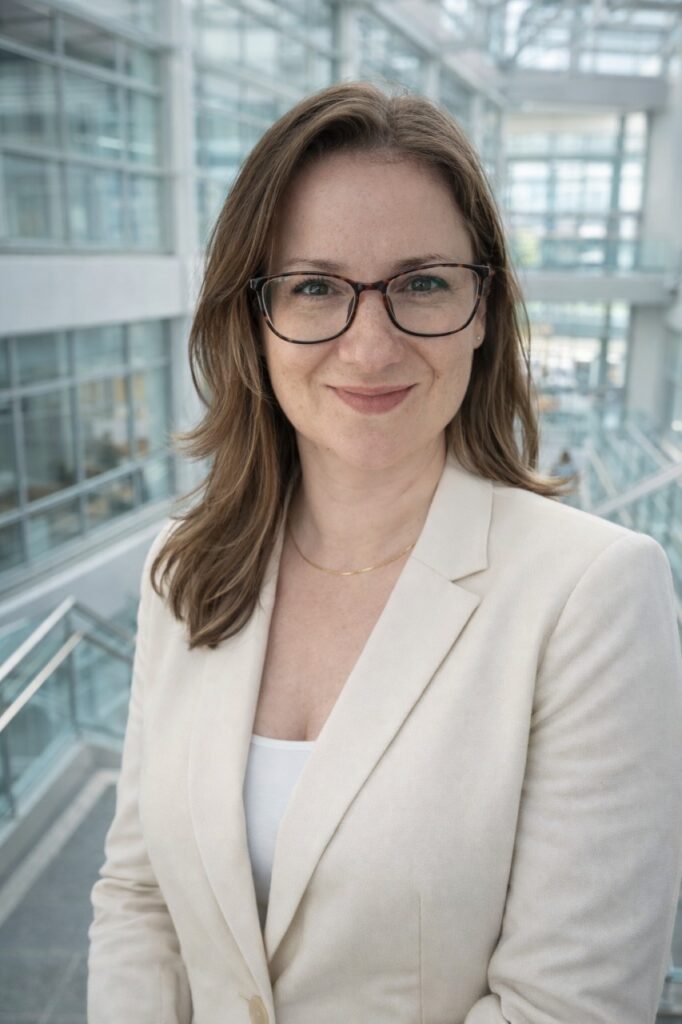
Meet Vika
Vika Lebedeva Baxter is the Co Founder and COO of Qincade, a specialist marketing agency serving life sciences and biotech organisations. Based in Cambridge in the United Kingdom, she has spent her career working at the intersection of marketing, science, and long term innovation, helping complex organisations translate their work into measurable growth.
Where Curiosity First Took Root
There is something quietly observant about Vika Lebedeva Baxter. She listens carefully. She considers context. She pauses before answering. For her, marketing has never been about noise. It has always been about understanding.
She was drawn to the discipline not because of campaigns or slogans, but because of human behaviour. Marketing, she realised early on, sits at the intersection of psychology and outcomes. It is where questions about why people choose intersect with the practical realities of how organisations survive and grow.
Her first role after university was in telesales for a publisher of luxury lifestyle magazines. It was not glamorous. It was structured, repetitive, sometimes uncomfortable. But it offered something foundational. It exposed her to persuasion, resilience, and the realities of commercial targets. It taught her that communication is rarely abstract. It has consequences.
From there, she moved into academic publishing and eventually into marketing at Cambridge University Press. At first, the shift felt incremental. Over time, it became transformative. She found herself energised by the practical experimentation marketing allowed. Testing messages. Analysing responses. Seeing how small changes influenced decisions.
Yet even then, she sensed that her path would not be linear. She describes her career not as a sequence of promotions but as a series of deliberate stretches into the unknown.
Choosing Growth Over Comfort
Motherhood reshaped her relationship with work. While raising her young daughters, she stepped into self employment as a marketing consultant. Flexibility was not optional. It was necessary. Those years required a different kind of discipline. There were no corporate structures to lean on. No established team dynamics. Just her, her judgement, and the responsibility to deliver.
She is clear about what that period demanded. It required confidence before she fully felt ready. It required resilience when outcomes were uncertain. It required her to trust her own thinking.
Later, when her daughters began school, she returned to senior marketing roles across a range of organisations. The pace was fast. The expectations were high. Within eight years, she had moved through multiple senior positions, each one demanding fluency in new industries, audiences, and internal politics.
Looking back, she does not frame those moves as ambition in the traditional sense. She sees them as decisions to choose growth over comfort.
She explains it simply.
“I am most proud of creating Qincade and the moments in my career where I chose to take risks rather than stay within what felt comfortable or predictable.”
Risk, for her, was not reckless. It was developmental. Stepping into more senior roles before feeling entirely prepared meant she had to learn quickly. She had to ask questions that might expose gaps in her knowledge. She had to tolerate uncertainty without the reassurance of established playbooks.
In high stakes sectors such as genomics and healthcare innovation, that uncertainty carries weight. Marketing is not merely about visibility. It is about credibility. It is about helping translate complex science into language that investors, partners, and wider audiences can trust.
There were rooms where she felt like the only voice asking for clarity. There were projects where benchmarks did not yet exist. Over time, she built confidence not through bravado but through evidence based experimentation and collaboration with subject matter experts. She learned persistence in environments where outcomes may take years rather than months to materialise.
Those experiences shaped how she leads today. They also shaped how she defines marketing itself.
Marketing as a Force for Good
For Vika, marketing is not cosmetic. It is structural.
She recalls working on the creation of a Startup School for the Wellcome Genome Campus. Seeing marketing activity contribute directly to the formation of new genomics companies altered her perspective. Later, supporting a 28 million dollar Series A raise for a cancer focused spin out reinforced the point. Marketing was not simply promoting innovation. It was enabling it.
She reflects on that shift in understanding.
“Marketing to me is a Science. It is a catalyst for social change, and it is a force for good no matter what people say about marketers.”
This belief sits at the core of her work at Qincade. The agency was co founded from a place of lived frustration. After years working in house, she understood the pressures marketing teams face within life sciences and biotech. Long sales cycles. Highly technical audiences. Fragmented data. Internal stakeholder expectations that are often misaligned with commercial realities.
Rather than criticise from the outside, she chose to build something different.
At Qincade, she and her team developed a lead nurturing system specifically designed for the complexity of scientific sectors. The premise is practical. Most organisations already have valuable relationships and content sitting within their CRM systems. What they lack is structure and clarity.
The system brings transparency to buyer journeys that often feel overwhelming. It helps teams use existing content more effectively. It creates consistent engagement that sales teams can act upon. The impact, she says, is visible not only in pipeline progression but in the emotional shift within teams.
Frustration gives way to confidence. Uncertainty becomes clearer signals. Conversations between marketing and sales become more grounded in shared evidence.
She notices success most in moments of clarity. When a colleague gains confidence because of something she has created. When a customer feels less overwhelmed. When complexity becomes navigable.
Freedom as a Definition of Success
If asked to summarise her idea of success in one word, she answers without hesitation. Freedom.
For her, freedom is not about status or recognition. It is about time. About making deliberate choices. About creating conditions that allow her children, her clients, and herself to live more fully.
That philosophy threads through her leadership style. She believes leadership is about creating the conditions for others to succeed. She takes visible pride in developing confidence and capability in the next generation of marketers entering an industry that is evolving rapidly.
Her values are consistent. Curiosity. Integrity over short term gain. Societal responsibility beyond personal benefit. Courage to take risks. Progress over perfection.
During challenging periods, she zooms out. She reads philosophy. She meditates. She draws inspiration from Stoic thinking, from the discipline of focusing on what can be controlled and accepting what cannot. She speaks of her father with quiet admiration, describing his kindness despite not always receiving the same in return. Everyday people who speak against injustice also inspire her. Not because of scale, but because of their courage.
This interior grounding influences how she approaches long term vision.
Building Systems That Outlast Individuals
Her ambition for Qincade extends beyond consultancy. The long term goal is to evolve their framework into a scalable SaaS platform. A system that life sciences and biotech organisations can access without the barriers that bespoke consulting often brings.
The motivation is practical but also philosophical. She wants marketing to be recognised as a genuine driver of revenue and strategic growth rather than a reactive function. When marketing impact becomes measurable and transparent, it earns its place at decision making tables.
Over time, she hopes this shift extends beyond scientific sectors into other industries facing similar complexity.
There is patience in how she speaks about the future. No grand proclamations. No exaggerated timelines. She believes in sustained effort. In mastery built slowly. In consistency over spectacle.
Her advice reflects that same measured perspective. Most careers, she says, are shaped quietly. Through small decisions. Through persistence. Through the willingness to keep learning even when progress feels incremental.
She encourages people not to avoid difficulty. Discomfort, in her experience, is often the path to growth. Pressure, sustained over time, produces strength.
A Quiet, Deliberate Legacy
When you step back from the specifics of lead nurturing systems and sector specialisation, what remains is something simpler.
Vika Lebedeva Baxter has spent her career translating complexity into clarity. She has chosen risk over predictability. She has built structures where there was ambiguity. She has aligned commercial growth with societal contribution.
Her story is not defined by a single dramatic turning point. It is defined by accumulation. Of courage. Of learning. Of small, consistent decisions that compound over time.
In an industry often criticised for superficiality, she insists on depth. In environments shaped by uncertainty, she brings structure. In conversations about growth, she speaks of freedom.
And perhaps that is the thread connecting it all. A belief that time is finite. That effort matters. That marketing, when practised with integrity and curiosity, can leave a positive trail in the world.
Not loud. Not performative. But lasting.
For More Features
Be Featured in The Real Edit!
Every story has the power to shape how we see innovation, leadership, and purpose. If you’re a founder, creator, executive, or changemaker with a journey worth telling , we’d be honored to help you share it.
To inquire about being featured:
Email us at: info@realedit.site
Follow The Real Edit