
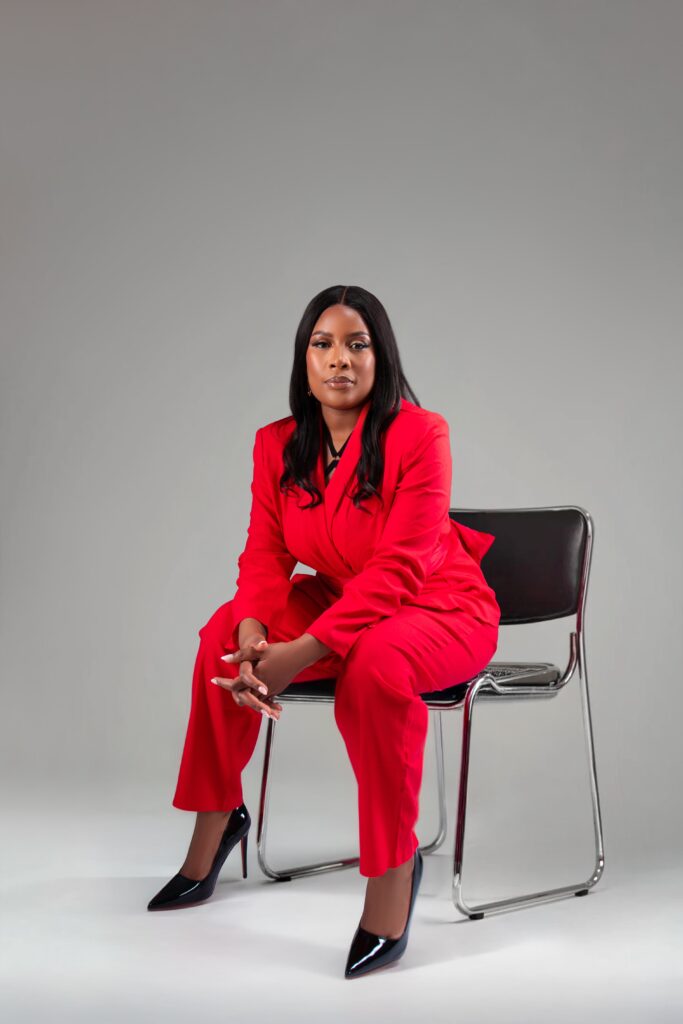
Meet Portia
Portia Hungwe is a Regensburg based Executive, Female founder consultant and Co-founder of SafeSign.Ai. Her work sits at the intersection of human centred artificial intelligence, decision making, and leadership. Shaped by migration, resilience, and lived experience, she helps individuals and organizations make clearer, fairer decisions in an increasingly complex technological world.
There is a steadiness in the way Portia Hungwe speaks about survival. Not because it was easy, but because it was necessary. Her story is not framed by ambition alone, but by a long series of quiet decisions to stay present, to keep learning, and to refuse the idea that systems or circumstances get to decide who she becomes. Today, she builds AI products and advises leaders navigating uncertainty. But long before titles and launches, her work began as an internal practice. Learning how to stay grounded when the ground kept shifting.
Where Control First Appeared
Portia’s earliest memories are rooted in a small town in Zimbabwe. Childhood for her was not a place of safety. It was marked by abuse, bullying, and the constant effort of surviving environments that offered little protection. For many children, school is a space of curiosity. For Portia, it was another battlefield. Yet inside that instability, she found something unexpectedly grounding.
Mathematics became her refuge.
Numbers were predictable. Problems had structure. Solutions followed logic rather than emotion. In a world where much felt arbitrary and unsafe, mathematics offered rules she could trust. She spent hours solving equations, not because she was being pushed, but because for the first time, she felt a sense of control over something. Mastery became a form of self protection.
That relationship with numbers would later open doors, but at the time, it served a simpler purpose. It gave her proof that she was capable, intelligent, and disciplined, even when the world around her tried to convince her otherwise. Education became her way out. Not just physically, but psychologically.
She pursued a bachelor’s degree in Statistics, holding onto the belief that competence could be her passport to stability. It was her ticket to leave home, and eventually, to leave the country.
Migration and the Cost of Starting Over
Moving to Germany was not the beginning of ease. It was the beginning of another kind of struggle. Migration demanded reinvention. Language barriers, cultural differences, and bureaucratic systems all required her to put parts of herself on hold. Despite holding a degree in a quantitative field, her qualifications did not translate easily within the German system.
Instead of entering the technology or data space she had trained for, Portia became an Au Pair. It was not a career decision. It was a survival decision. She describes that period as traumatic in its own way, a continuation of having to shrink her capabilities to fit what the system allowed. Afterward, she spent over a year doing voluntary work, followed by formal training as a healthcare worker.
This path was not driven by passion. It was driven by structural barriers. When she applied for tech apprenticeships, some companies told her directly that she did not belong there, despite her background in statistics and mathematics. The message was subtle at times and explicit at others. This is where you fit. This is where you should stay.
Yet even then, she did not let go of her original direction. She adapted without surrendering. Healthcare work taught her discipline, empathy, and responsibility, but it never replaced her deeper interest in systems, data, and decision making. The detour was long, but it did not erase her sense of self.
Choosing Her Place Again
Rather than retreat, Portia made a decision that surprised many around her. One month after finishing nursing school, she enrolled in a Master’s program in Applied AI for Digital Production Management. The transition was not welcomed by everyone.
At the foreign office, an official questioned her decision openly. Why study engineering when she had already been in healthcare? According to that official, her place was already defined. The resistance went beyond paperwork. It questioned her intellectual capacity to succeed in a German AI engineering program.
Portia did not respond with anger. She responded with evidence. Her foundation in statistics and mathematics was not erased by migration or career detours. She insisted on her right to be in those classrooms. The program was demanding. So was proving herself again. But she did not aim to simply pass. She aimed to excel.
While writing her Master’s thesis on Industry 4.0 in manufacturing, something clicked. Beyond the technology itself, she became fascinated by the decisions surrounding AI adoption. Who decides to implement AI. Why they do it. What fears, assumptions, and power dynamics shape those choices. The technical layer was only one part of the story. The human layer was far more complex.
The Shock That Changed Everything
After completing the first two semesters of her Engineering degree, Portia faced a moment that would stay with her for years. She had secured employment with SGL Carbon. Just two days before her official start date, the company cancelled her contract. The disappointment wasn’t the sudden loss of an opportunity, it was the reason. After months of interviews and waiting, it wasn’t her skills that were not good enough, not her English or German skills. It was her nationality. Being Zimbabwean was the reason to lose the job. This left a mark of trauma and resilience at the same time.
What made the experience devastating was not only the loss of income or opportunity, but the belief that stability had finally arrived. Employment had been positioned as the reward for endurance. When it disappeared without warning, it shattered her trust in systems she had worked hard to integrate into.
“Believing that employment would set my career journey up and have that taken away is something that really shocked me, got me into depression and question my dependency on systems,”
The emotional toll was heavy. Depression followed. So did deep questioning. A year later, when she attempted to seek legal recourse, she was told she was too late. She should have acted within three months. The realization that she had unknowingly signed away her options stayed with her. It raised a painful question. How many people accept unfair terms simply because they do not understand the documents in front of them, let alone in a language that’s not their native?
That question would eventually become the foundation of her work.
From Lived Experience to Purpose
Portia’s interest in AI decision making was not abstract. It was personal. She had lived through the consequences of opaque systems, unclear ownership, and decisions made without accountability. Her consulting work emerged from that understanding.
She began building a practice focused on helping executives stop and ask the right questions. Not what tools to buy, but why they are buying them. Not what competitors were doing, but what problem they were actually trying to solve.
“My consultancy work focuses on bringing those on the decision table to a place of looking within. Asking the important questions that otherwise are avoided or ignored,”
Her approach is grounded in human centred AI. She believes technology should serve people, not intimidate them. That clarity and leadership matter more than speed. That fear driven adoption often leads to waste, confusion, and mistrust.
At the same time, her personal experience with contract injustice resurfaced in a new form. Alongside her business partner, she co founded SafeSign.AI, a legal AI product designed to help individuals and companies understand legal documents before signing them. Employment contracts, NDAs, and other agreements are often signed under pressure, without full comprehension. SafeSign.AI flags critical clauses and risks, empowering users to make informed decisions.
For Portia, this was not just a startup. It was a response to a wound that had never fully closed.
Leadership Shaped by Survival
Portia describes her leadership as something that emerged early, not out of ambition, but necessity. Childhood circumstances forced her to mature quickly. Responsibility became instinctive. Over time, that instinct evolved into intentional leadership grounded in mentorship and learning.
She believes deeply in being guided as well as guiding others. She has both life and business mentors and speaks openly about the role of spirituality in sustaining her through uncertainty. Resilience, for her, is not a slogan. It is a lived reality shaped by abuse, migration, rejection, and persistence.
Her work extends beyond AI. She is involved in projects aimed at creating employment opportunities, connecting Africans across borders through the AfroCom app, and empowering small scale farmers in rural African communities. These initiatives are not side projects. They reflect her belief that technology and leadership should reduce barriers, not reinforce them.
Vision Beyond the Present
Looking ahead, Portia is focused on expanding her impact thoughtfully. She is preparing for Executive Management role with a US based company while continuing her consulting and product work. She is interested in long term investment projects in Africa and in building systems that allow others to access opportunities without having to fight the same battles she did.
She is also deeply aware of representation. Clear AI voices are rare, and women, particularly African women, remain underrepresented in decision making spaces. Portia does not position herself as an exception. She positions herself as proof that systems can be challenged from within, without losing humanity in the process.
Her work consistently returns to the same question. How do we make decisions that are defensible, explainable, and humane. Whether in AI adoption, legal agreements, or leadership structures, she believes clarity is an act of care.
Closing Reflection
Portia Hungwe’s story is not about overcoming once and moving on. It is about choosing herself repeatedly, even when the cost was high. She does not romanticize struggle, but she honors what it taught her. That survival builds discernment. That clarity is power. And that leadership, at its core, is about protecting people from harm they should never have to normalize.
For More Features
Be Featured in The Real Edit!
Every story has the power to shape how we see innovation, leadership, and purpose. If you’re a founder, creator, executive, or changemaker with a journey worth telling , we’d be honored to help you share it.
To inquire about being featured:
Email us at: info@realedit.site
Follow The Real Edit